Cause of Russina Policies Agains Toward Serfs
The Authorities reforms imposed by Tsar Alexander 2 of Russia, oft called the Bang-up Reforms (Russian: Великие реформы, romanized: Velikie reformy ) past historians, were a series of major social, political, legal and governmental reforms in the Russian Empire carried out in the 1860s.
By far the most of import was the Emancipation reform of 1861 which freed the 23 million serfs from an junior legal and social condition, and helped them buy a farm. Many other reforms took place, including the:
- relaxation of censorship of the media
- Judicial reform of Alexander II
- modernization of the army and navy
- zemstva and other innovations in local government
- educational innovations including the expansion and reform of universities, elementary schools and secondary schools
- reform of the Russian Orthodox Church
- economic modernization impacting banking, railways, mining, manufacturing
- emancipation of the peasants in Poland
- improved the status of Jews.
By 1865 reaction began, and some reforms were cutting back. After the tsar's assassination in 1881, his successor Alexander III reversed many reforms.
Background [edit]
The Russian Empire in the 19th century was characterized past very bourgeois and reactionary policies issued by the autocratic tsars. The cracking exception came during the reign of Alexander II, (1855-1881), especially the 1860s. By far the greatest and most unexpected was the abolition of serfdom, which afflicted 23 million of the Empire's population of 74 million. They belonged to the country, to monasteries and to 104,000 rich gentry landowners—it was the concluding group that was emancipated first.[1]
As soon as he became tsar Alexander ready numerous commissions that studied various proposals for reforms in practically every area. Experts debated in draft of the proposals, but Alexander made all the last decisions.
While the emancipation of the serfs in 1861 was the well-nigh famous and dramatic reform, a host of new reforms afflicted diverse areas.[2] [iii] The tsar appointed Dmitry Milyutin to carry out meaning reforms in the Russian armed services. Further important changes were made concerning industry and commerce, and the new liberty thus afforded produced a large number of limited liability companies.[4] Plans were formed for edifice a great network of railways, partly to develop the natural resources of the country, and partly to increment its power for defense and set on.[v]
A new judicial administration (1864), based on the French model, introduced security of tenure.[half dozen] A new penal code and a profoundly simplified system of civil and criminal procedure besides came into functioning.[7] Reorganisation of the judiciary occurred to include trial in open up courtroom, with judges appointed for life, a jury arrangement and the cosmos of justices of the peace to bargain with minor offences at local level. Legal historian Sir Henry Maine credited Alexander II with the first not bad attempt since the time of Grotius to formulate and humanise the usages of war.[eight]
Part of Tsar Alexander II [edit]
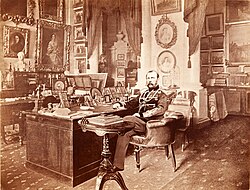
When Alexander Ii ascended the throne in 1855, the largely peasant conscripted regular army in the Crimean war was a national disgrace, and clearly demonstrated that despite its large size, the Russian regular army was no longer competitive to smaller industrial powers such as Britain and France. The demand for reform was widespread, just unorganized. There been piddling consideration of how the complex economic, social, political, and legal roles of the service would be ended. The Tsar decided to cancel serfdom from above, setting up a new system whereby the land would be able to purchase farmland from the landowners and sell information technology to the freed serfs. The Tsar told Moscow nobles: "Improve that the reform should come from in a higher place than wait until serfdom is abolished from beneath."[nine] Historians take debated Alexander's role. Soviet era historians downplayed him, as they believed social forces acquired history not individuals. Not-Marxist critics say he did not make it enough, especially since he rejected any parliament or duma.
His top advisors included Count Michael von Reutern, Finance Government minister, 1862-1878, and the brothers Nikolay Milyutin (1818-1872).[10] and Field Marshal Dmitry Milyutin. Minister of War Dmitry Milyutin (1861–81) was responsible for sweeping military reforms. He was also instrumental in creating the framework for the Circassian genocide that led to the deaths of big numbers of Circassian refugees from 1861 to 1865.[11] [12]
Boris Chicherin (1828-1904) was a political philosopher who believed that Russia needed a strong, authoritative regime by Alexander to brand possible all the of import reforms that did take identify. He praised Alexander for the range of his central reforms, arguing that the tsar was:
- called upon to execute one of the hardest tasks which tin can face up an autocratic ruler: to completely remodel the enormous state which had been entrusted to his intendance, to abolish an age-former order founded on slavery, to replace it with civic decency and liberty, to plant justice in a country which had never known the meaning of legality, to redesign the entire administration, to innovate liberty of the press in the context of untrammeled potency, to call new forces to life at every turn and set them on firm legal foundations, to put a repressed and humiliated society on its anxiety and to requite it the chance to flex its muscles.[xiii]
Censorship and glasnost [edit]
In 1858 he removed most of the censorship restrictions on the media—newspapers, magazines, books and pamphlets, resulting in an explosion of new publications. Thus Alexander achieved a caste of "glasnost" or open discussion, equally the new media were often filled with discussions of reforms that were urgently needed.[14] [15] [16]
Serfdom [edit]

Emancipation of the serfs 1861 [edit]
The emancipation reform of 1861 that freed 23 one thousand thousand serfs was the unmarried most important event in 19th-century Russian history, and the beginning of the end for the landed aristocracy'southward monopoly of power.[17] The decree ended the feudal obligations owed by serfs and allotted them land. The owners received Treasury bonds, which amounted to liquid capital. The peasants who stayed on the state were obliged to brand redemption payments to their obshchina (the hamlet mir, or commune) over a 49-year period.[18]
Besides liberating the serfs from tight control by the gentry, emancipation brought a supply of free labour to the cities—including both peasants and gentry. This stimulated industry by providing a working course and the middle class grew in number and influence. All the land and property turned over to the peasants was endemic collectively by the mir, the village community, which divided the country among the peasants and supervised the diverse holdings. Revolutionaries were not satisfied. They believed that the newly freed serfs were merely being sold into wage slavery by the bourgeoisie.[19] [20] Revolutionaries calling themselves Narodnaya Volya (the People's Will) fabricated multiple attempts to assassinate Alexander II, and they succeeded in 1881.[21]
Role of gentry [edit]
While about of the landowning gentry were conservative, the strong liberal element was more articulate. They vigorously argued that serfdom was severely restricting the entrepreneurial opportunities of the gentry. They proposed that emancipation of the serfs, financed by the government, would provide the gentry and the nobles with capital letter to invest in the sort of economic opportunities that were existence demonstrated in Western Europe. These innovative schemes came especially from the liberal gentry in Tver province. The plan was to utilise regime loan and then that freed serfs could purchase farms from the gentry. The gentry would then have the capital to begin entirely new enterprises not restricted by the low returns to farming in the cold Russian climate. In tardily 1858 Alexander II gear up up a commission to study emancipation and the liberal ideas proved attractive. However the regime bureaucrats shut out the liberals from the actual planning, much to their dismay. A compromise was reached whereby the gentry was given extensive new roles in zemstvos created to operate local authorities.[22]
State serfs [edit]
The national authorities also owned serfs, called state serfs until they too were emancipated in November 1866. The tsar promulgated a law "On the Land Device Land Peasants", allowing the rural society to maintain country in their possession with the rights of "ownership". Redemption from the government of the property holdings was regulated by the law of 12 June 1886. Later the implementation of these reforms, plots of state peasants were reduced by x% in the central provinces and 44% – in the northern. Payments were calculated for 49½ years, and in some cases had to be fabricated earlier 1931, but were canceled on ane Jan 1907 as part of the Stolypin agrarian reform nether the influence of the revolution in 1905.[23]
Judiciary [edit]
The judicial reforms were among the most successful and consistent of all his reforms.[24] A completely new court arrangement and order of legal proceedings were established. The master results were the introduction of a unified judicial organisation instead of a cumbersome prepare of estates of the realm courts, and fundamental changes in criminal trials. The latter included the establishment of the principle of equality of the parties involved, the introduction of public hearings, the jury trial, and a professional advocate that had never existed in Russia. All the same, at that place were also problems, equally sure obsolete institutions were not covered by the reform. Also, the reform was hindered by extrajudicial punishment, introduced on a widespread scale during the reigns of his successors – Alexander Three and Nicholas 2.[25]
The judicial reforms started on twenty November 1864, when the tsar signed the decree which enforced four Regulations (Institution of Judicial Settlements, Regulations of Civil Proceedings, Regulations of Criminal Proceedings, and Regulations of Punishments Imposed past Justices of the Peace). One of the nearly important results of the reform was wide introduction of jury trials. The jury trial included iii professional person judges and twelve jurors. A juror had to possess real manor of a certain value. Unlike in modernistic jury trials, jurors not simply could decide whether the defendant was guilty or not guilty only also could determine that the defendant was guilty merely non to be punished, as Alexander Two believed that justice without morality is wrong. The sentence was rendered by professional judges.[26]
Military [edit]
Dmitry Milyutin as war minister, focused on rebuilding a very big, very poor army into one that could compete with modern western armies, as well as deal with ethnic groups on the fringes of the empire.[27] [28] In the old system conscription was compulsorily enforced only for the peasantry. It was for 25 years for serfs, and they were selected by the landowners. The effect was an infantry filled primarily with poorly qualified, poorly motivated and incompetent soldiers.[29] The new reforms included universal conscription, introduced for all social classes starting in 1874. Other armed services reforms included extending the reserve forces and the military district system, which split the Russian states into 15 military districts. Railway planning emphasized strategic Strategic lines connecting population centers to likely battlefields. Armed services education was dramatically improved for the officer corps. Corporal punishment in the armed services and branding of soldiers as penalization were banned.[xxx] [31] The first great task of the reconstituted army was defeating the Ottoman Empire and the Balkan wars of 1877. Whilst the war was won, serious failures were discovered at every level of the ground forces from poorly trained companies, to outmoded tactics to dilatory maneuvers, to failures of overall strategy at the top command level.[32] [33]
Naval reforms were also attempted, however inexperienced private Russian shipyards were used to build a mod steel fleet. The Russians tried to save money by inventing their own technology rather than purchasing the latest models from Western Europe. Alexander II also made the mistake of putting his brother in charge of the Navy, and and so playing his ministers against each other to save money. Consequently naval programs were poorly coordinated with other ministries. In any case most of the budget went to the Army and Russian federation was never able to catch up with even the second-tier European naval powers.[34]
Local government [edit]
Alexander'south bureaucracy instituted an elaborate scheme of local self-government (zemstvo) for the rural districts (1864) and the big towns (1870), with elective assemblies possessing a restricted right of revenue enhancement, and a new rural and municipal law under the direction of the Minister of the Interior. All owners of houses, tax-paying merchants and workmen were enrolled on lists in a descending guild according to their assessed wealth. The full valuation is then divided into iii equal parts, representing iii groups of electors very unequal in number, each of which elects an equal number of delegates to the municipal duma. The executive is in the hands of an constituent mayor and an uprava, which consists of several members elected by the duma. The gentry played the leading role in most localities, and indeed the new arrangement was designed for them.[35]
Education [edit]
Earlier 1860 Russian federation had a scattershot educational programme that featured a few good universities, but severe limitations in every other area. Planning began in 1858, and the primary reforms came in 1863. They extended popular pedagogy, opened secondary schools to women and immune some women to audit Academy courses. Universities obtained more autonomy, but when small-scale-scale student protests erupted, universities were returned to closer supervision. Individual groups opened over 500 Sun schools, without government funding or supervision, just the government distrusted innovations—such equally didactics history—in place of rote language drills and closed them downward .[36] Although new funding was not made available, laws in 1864 reformed secondary schools along the lines typical in France and Prussia. Elementary schools likewise were regulated to emphasize religious teaching by Orthodox priests.[37]
Economic system [edit]

Count Michael von Reutern, Finance Minister, 1862-1878
The extreme difficulties of financing the Crimean war, and the military machine weakness caused by an ineffective railway system, made economical reforms a high priority. A state depository financial institution was founded in 1860, and municipal banks in 1862, too as savings banks in 1869, all under national supervision. A systematic overhaul of national finances was accomplished in 1862 by legislation that created a ministry of finance under Count Michael von Reutern (1862-1878), along with a regular national upkeep supervised by the finance government minister. Reutern installed a uniform system of public accounting for government agencies. Revenue enhancement collection was no longer handled by private farmers, but became a regular national bureaucratic upshot. There was no income taxation yet, in fact the poll taxation was connected, merely the much hated salt tax was abolished. He promoted private credit institutions and stabilised the rouble. Authorities revenues rose significantly, the chronic budget deficit was eliminated past 1867 and surpluses were achieved from 1873. On trade policy Reutern pragmatically supported reducing some tariffs and duties on manufacturing appurtenances in 1863 and 1868. A balanced budget facilitated borrowing from Western Europe, using land guaranteed railway bonds. This made possible the rapid expansion of the railway system. The Russian-Turkish war ran upwardly deficits and he resigned in 1878.[38] [39]
The new favorable environment encouraged entrepreneurship. In 1860 in that location were 78 joint stock companies, with a capital of less than viii million roubles each. Between 1861 and 1873, businessmen set up 357 articulation stock companies with a capital letter of 1.ane billion roubles. They included 73 banks, 53 railways and 163 factories. Foreign capital started arriving for the first time, although massive amounts had to wait for the alliance with French republic in the 1890s.[40]
Poland [edit]
Under Alexander Two Shine nobles demanded greater autonomy. This demand was rejected past the Tsar'south quango. Instead there were new restrictions on internal mobility inside Poland, including requiring passports. In response to unrest the Tsar appointed a moderate Aleksander Wielopolski every bit chief government minister in 1862. Wielopolski was conservative, pro-Russian, a proponent of regaining Poland's pre-1830 autonomy, and a champion of the emancipation of Jews. He adopted a series of liberal reforms in education, for Jews and peasants. He undertook educational reforms, increasing the number of Smoothen-language schools and establishing in Warsaw the "Main School" (Szkola Glowna, today'due south University of Warsaw). He also enacted banking-system reforms and agricultural reform for peasants in the course of rents instead of serfdom.[41] [42]
A major revolt broke out in Jan 1863. It was brutally crushed by the Russian army, despite frequent demands across Europe for leniency and reforms. Nikolay Milyutin was installed as governor and he decided that the best response to the revolt was to make reforms regarding the peasants.[43] Emancipation of the Smooth peasantry from their serf-like status took place in 1863, on more generous terms than the Russian emancipation of 1861. However the ramble's independence of Poland was weakened and the Catholic Church lost its backdrop. In Warsaw, the official language of teaching was now to be Russian.[44]
Finland [edit]
The diet or Parliament of Republic of finland had not met in 55 years, but in 1863 Alexander called information technology into session. It passed a language police force that would brand Finnish equal with Swedish in all public business. Mass protests erupted across Finland in 1898 when Tsar Nicholas II reversed the policy and made Russian the official language.[45] [46]
Jews [edit]
Under Alexander'southward rules Jews could non hire Christian servants, could non ain land, and were restricted in travel. However special taxes on Jews were eliminated and those who graduated from secondary school were permitted to live outside the Pale of Settlement, and became eligible for land employment. Big numbers of educated Jews moved as soon as possible to Moscow and other major cities. Jews were blamed for the bump-off of Alexander II. The backlash was vehement and conditions grew much worse.[47] [48]
Alaska [edit]
The Alaska colony was losing coin, and would be impossible to defend in wartime against Great britain, so in 1867 Russia sold Alaska to the United States for $vii.2 meg (equivalent to roughly $200 million in current dollars), The Russian administrators, soldiers, settlers, and some of the priests returned habitation. Others stayed to minister to their native parishioners, who remain members of the Russian Orthodox Church into the 21st century.[49]
Rejection of a parliament [edit]
Alexander firmly believed he had the God-given duty to dominion as an despot, and that he alone understood the best interests of all of the people of Russia. Therefore he rejected whatever idea of a constitution that would limit his authority, and rejected whatsoever parliament or Duma that would take over some of the responsibilities that he lone could perform.[l]
Catastrophe the reform era and a return to conservatism [edit]
The get-go decade of the rule of Alexander II strongly promoted reforms in many areas. In sharp contrast, the residue of his term after 1865 saw the growing forcefulness of conservatives and reactionaries who reversed or limited many of the reforms. Reactionary elements grew strength from the increasingly trigger-happy deportment of the revolutionary underground.[51]
Historian Orlando Figes has argued:
- Had the liberal spirit of the 1860s continued to pervade the piece of work of regime, Russia might take become a Western-style society based upon individual property and liberty upheld by the rule of law. The revolution demand not have occurred....At that place was at least, within the ruling aristocracy, a growing awareness of what was needed....The problem was, however, that the elite was increasingly divided over the desirability of this transformation, and equally a consequence of these divisions it failed to develop a coherent strategy to bargain with the challenges of modernization.[52]
Retentivity and historiography [edit]
According to Russian scholar Larisa Zakharova:
- The abolition of serfdom in 1861, under Alexander II, and the reforms which followed (local regime reforms, the judicial reform, the abolition of corporal punishment, the reform of the military, public education, censorship and others), were a 'watershed', 'a turning betoken' in the history of Russia. This is the verdict of the reformers themselves and their opponents, people who lived at the fourth dimension in Russia likewise as across its borders, and many researchers. This theme remains crucial for historians. But in particular periods such as during the 1905 Revolution or Gorbachev'due south perestroika, interest in the history of Alexander II'south reforms has acquired a detail topicality and political colouring.[53]
In Russia, the bulk of serious commentary on the emancipation of the serfs was highly favorable before 1917, With Alexander playing a cardinal role. Soviet historians minimized Alexander and the other personalities , arguing that the crisis in feudalism forced the rulers to compromise. The primal Leninist interpretation was that the concessions were but a tactical response to a concerted attack on the status quo by rural masses and their urban allies. Western historians have more often than not agreed that fright of further upheaval played a minor role in the decision.[54]
See also [edit]
- Government reform of Peter the Great
- Government reform of Alexander I
- Reform movement#Russia 1860s
- Stolypin reform
- Judicial reform of Alexander II
References [edit]
- ^ Wayne Vucinich, ed. The Peasant in Nineteenth-Century Russian federation (1968) p 41.
- ^ Due west. Bruce Lincoln, The smashing reforms: Autocracy, bureaucracy, and the politics of modify in imperial Russia (Northern Illinois Upward, 1990.
- ^ Ben Eklof, John Bushnell, and Larisa Georgievna Zakharova, eds. Russian federation's great reforms, 1855-1881 (Indiana Upwardly, 1994.
- ^ "The new volumes of the Encyclopædia Britannica: constituting, in combination with the existing volumes of the 9th edition, the tenth edition of that work, and also supplying a new, distinctive, and independent library of reference dealing with recent events and developments ..." A. & C. Black. 29 December 2017 – via Google Books.
- ^ Donald Mackenzie Wallace, "Alexander Ii (1818–1881)". The Encyclopaedia Britannica (1910). ane:pp. 559–61
- ^ An Introduction to Russian History (1976), edited by Robert Auty and Dimitri Obolensky, chapter by John Go along, p. 238
- ^ Wallace, "Alexander II" (1910) pp. 559–61.
- ^ Maine, Henry (1888). International Law: A Series of Lectures Delivered Earlier the University of Cambridge, 1887 (1 ed.). London: John Murray. p. 128. Retrieved 29 September 2015.
- ^ Paul S. Boyer etc (2010). The Indelible Vision, Volume I: To 1877. Cengage. p. 488. ISBN978-0495800941.
- ^ Due west. Bruce Lincoln, Nikolai Miliutin, an enlightened Russian Bureaucrat (1977).
- ^ Forrest A. Miller, Dmitrii Miliutin and the Reform Era in Russia (1968)
- ^ Walter Richmond, The Circassian Genocide (Rutgers UP, 2013), pp 70-71, 131-34.online
- ^ Quoted in David Saunders, ''Russia in the historic period of reaction and reform: 1801–1881'' (1992) p. 213
- ^ Alfred J. Rieber, ed. (2019). The politics of autocracy: Letters of Alexander Two to Prince A. I. Bariatinskii. 1857–1864. De Gruyter. p. 12. ISBN978-three-11-158150-7.
- ^ Seton-Watson, The Russian Empire 1801-1917 p 358.
- ^ W. Bruce Lincoln, "The Problem of Glasnost'in Mid-Nineteenth Century Russian Politics." European Studies Review 11.two (1981): 171-188.
- ^ Rieber ed. The politics of autocracy p 15.
- ^ David Moon, The Abolition of Serfdom in Russian federation: 1762-1907 (2001) pp 70-83.
- ^ J. Bowyer Bong (2017). Assassin: Theory and Practice of Political Violence. Taylor & Francis. p. 118. ISBN9781351315425.
- ^ Joseph Stalin (2017). Leninism: Volume One. pp. 54–55. ISBN9781351791939.
- ^ M. Wesley Shoemaker (2012). Russian federation and the Commonwealth of Independent States . Rowman & Littlefield. p. 27. ISBN9781610488938.
- ^ Terrence Emmons, The Russian Landed Gentry and the Peasant Emancipation of 1861 (1968).
- ^ Roger Bartlett, "Serfdom and state power in imperial Russian federation." European History Quarterly 33.ane (2003): 29-64.
- ^ Ben Eklof, , John Bushnell, and Larisa Georgievna Zakharova, eds. Russia's great reforms, 1855-1881 (Indiana UP, 1994) pp 214-46.
- ^ Richard Wortman, "Russian monarchy and the rule of law: New considerations of the court reform of 1864." Kritika: Explorations in Russian and Eurasian History 6.1 (2005): 145-170.
- ^ Samuel Kucherov, "The Jury as Part of the Russian Judicial Reform of 1864." American Slavic and East European Review ix.two (1950): 77-xc.
- ^ W. Bruce Lincoln, "General Dmitrii Milyutin and the Russian Army," History Today (1976) 26#1 pp 40-47.
- ^ W. Bruce Lincoln, The Great Reforms pp 143-160.
- ^ Jonathon Bromley, "Russia 1848–1917"
- ^ Edvard Radzinsky, Alexander Ii: The Last Great Tsar, pp. 150–51.
- ^ Forrest A. Miller, Dmitrii Miliutin and the Reform Era in Russia (1968)
- ^ John Due south. Bushnell, "Miliutin and the Balkan War: armed forces reform vs. military performance," in Ben Eklof et al., Russian federation's rate reformers, 1855-1881 (1994) pp 139-158.
- ^ E. Willis Brooks, "Reform in the Russian Army, 1856-1861" Slavic Review 43#1 (1984), pp. 63-82 Online
- ^ Jacob Due west. Kipp,, "The Russian Navy and the Problem of Technological Transfer," in Ben Eklof et al., Russia's rate reformers, 1855-1881 (1994) pp 115-138.
- ^ Terence Emmons and Wayne S. Vucinich, eds. The Zemstvo in Russia: An Experiment in Local Cocky-Government (Cambridge Upward, 1982).
- ^ Saunders, Russia in the Historic period of Reaction and Reform 1801-1881 (1992) pp 250-52, 257-58.
- ^ Seton-Watson, The Russian Empire 1801-1917 (1967) pp 357-61.
- ^ Arthur Raffalovich, "Russian Financial Policy (1862-1914)" Economic Journal (1916) 26#104 pp. 528-532 Online
- ^ Valentine Tschebotarioff Bill, "The Early on Days of Russian Railroads." The Russian Review 15.1 (1956): 14-28. online
- ^ Seton-Watson, The Russian Empire 1801-1917 (1967) pp 408-409.
- ^ Jonathan Bromley, Russia 1848–1917 (2002) pp 41-43.
- ^ Stanley J. Zyzniewski, "The Futile Compromise Reconsidered: Wielopolski and Russian Policy in the Congress Kingdom,] 1861-1863." American Historical Review 70.two (1965): 395-412. online
- ^ W. Bruce Lincoln, "The Makings of a New Polish Policy: N. A. Milyutin And The Smoothen Question, 1861-1863." Polish Review (1970): 54-66. online
- ^ Zyzniewski, Stanley J. "The Russo-Shine Crucible of the 1860s: A Review of Some Recent Literature." The Polish Review (1966): 23-46. Online
- ^ Jonathan Bromley, Russia 1848–1917 (2002) pp 43-44, 63-64.
- ^ David Kirby, A Concise History of Republic of finland (2006) pp 105-49.
- ^ Sara Eastward. Karesh and Mitchell M. Hurvitz (2005). Encyclopedia of Judaism. Infobase. pp. 10–xi. ISBN9780816069828.
- ^ James P. Duffy, Vincent L. Ricci, Czars: Russia's Rulers for Over 1 One thousand Years, p. 324
- ^ James R. Gibson, "Why the Russians Sold Alaska." Wilson Quarterly three.iii (1979): 179-188. Online
- ^ Seton-Watson, The Russian Empire 1801–1917, p 333.
- ^ Saunders, Russia in the Age of Reaction and Reform 1801-1881 (1992) pp xi-xii, 263-72.
- ^ Orlando Figes, ''A People'southward Tragedy: A history of the Russian Revolution'' (1996) p. forty.
- ^ Larisa Zakharova, "The reign of Alexander II: a watershed?" in Dominic Lieven, ed., The Cambridge History of Russian federation Book 2: Imperial Russia, 1689-1917 (2006) pp. 593-616 quoting p. 593.
- ^ N. 1000. O. Pereira, "Alexander Two and the Conclusion to Emancipate the Russian Serfs, 1855-61." Canadian Slavonic Papers 22.1 (1980): 99-115. online
Farther reading [edit]
- Almendingen, E.K. The Emperor Alexander 2 (1962)
- Eklof, Ben; John Bushnell; Fifty. Larisa Georgievna Zakharova (1994). Russia's Not bad Reforms, 1855–1881. ISBN978-0-253-20861-3.
- Emmons, Terence, and Wayne S. Vucinich, eds. The Zemstvo in Russian federation: An Experiment in Local Cocky-Government (Cambridge UP, 1982).
- Lincoln, W. Bruce. The Dandy Reforms: Autocracy, Bureaucracy, and the Politics of Alter in Imperial Russia (1990)
- Lincoln, W. Bruce. Nikolai Miliutin, an enlightened Russian bureaucrat (1977)
- Miller, Forrest A. Dmitrii Miliutin and the Reform Era in Russia (1968)
- Moss, Walter G. A history of Russia: volume I to 1917 ( 1997), pp 413–35.
- Mosse, W. E. Alexander Two and the Modernization of Russia (1958) online
- Orlovsky, Daniel T. The Limits of Reform: The Ministry of Internal Diplomacy in Purple Russian federation, 1802-1881 (Harvard UP, 1981).
- Pereira, N.G.O.,Tsar Emancipator: Alexander II of Russia, 1818–1881, Newtonville, Mass: Oriental Inquiry Partners, 1983.
- Polunow, Alexander (2005). Russia in the Nineteenth Century: Autocracy, Reform, And Social Modify, 1814–1914. M E Sharpe Incorporated.
- Radzinsky, Edvard, Alexander II: The Terminal Swell Tsar. (2005).
- Rieber, Alfred J. "Alexander Two: A Revisionist View." Journal of Modernistic History 43.1 (1971): 42-58. Online
- Saunders, David. Russia in the Age of Reaction and Reform: 1801 – 1881 (1992).
- Seton-Watson, Hugh. The Russian Empire 1801-1917 (Oxford Upward, 1967) pp 332–429.
- Watts, Carl Peter. "Alexander II's Reforms: Causes and Consequences" History Review (1998): 6-fifteen. Online
- Wcislo, Francis William. Reforming rural Russia: State, local social club, and national politics, 1855-1914 (Princeton, 2014).
- Zakharova, Larisa. "The reign of Alexander II: a watershed?" in Dominic Lieven, ed., The Cambridge History of Russia Book ii: Royal Russia, 1689-1917 (2006) pp. 593–616
Emancipation of serfs [edit]
- Domar, Evsey. "Were Russian Serfs Overcharged for Their Land past the 1861 Emancipation? The History of One Historical Tabular array." Research in Economical History Supplement 5b (1989): 429-439.
- Easley, Roxanne. The emancipation of the serfs in Russian federation: Peace arbitrators and the development of ceremonious guild (Routledge, 2008).
- Emmons, Terence, ed. Emancipation of the Russian serfs (1970), 119pp. Curt excerpts from primary and secondary sources.
- Emmons, Terence. The Russian Landed Gentry and the Peasant Emancipation of 1861 (1968) review
- Field, Daniel. The Terminate of Serfdom: Nobility and Hierarchy in Russia, 1855-1861 (1976)
- McCaffray, Susan P. "Confronting Serfdom in the Historic period of Revolution: Projects for Serf Reform in the Fourth dimension of Alexander I", Russian Review (2005) 64#i pp ane–21 online
- Moon, David. The Abolition of Serfdom in Russia: 1762-1907 (2001). links
- Pereira, N. G. O. "Alexander Ii and the Determination to Emancipate the Russian Serfs, 1855-61." Canadian Slavonic Papers 22.ane (1980): 99-115. online
- Pushkarev, Sergei G. "The Russian Peasants' Reaction to the Emancipation of 1861." Russian Review 27.2 (1968): 199-214. online
- Robinson, Geroid. Rural Russia under the Old Regime (tertiary ed. U of California Press, 1972).
- Vucinich, Wayne, ed. The Peasant in Nineteenth-Century Russian federation (1968)
Master sources [edit]
- Freeze, Gregory L. ed. From Supplication to Revolution: A Documentary Social History of Imperial Russia (1989), pp 197–247. Includes 28 statements by the dignity, hierarchy, Army, clergy, professionals, merchants, peasants, industrial workers, religious minorities and women.
External links [edit]
- Serfdom: The Life of East Europe'due south Masses
- The Causes of Slavery or Serfdom: A Hypothesis
clevelandstine1951.blogspot.com
Source: https://en.wikipedia.org/wiki/Government_reforms_of_Alexander_II_of_Russia
0 Response to "Cause of Russina Policies Agains Toward Serfs"
Post a Comment