How Did the Numbers and Conditions of Women Affect Family Life
Piece of work & Family
Women make up virtually one-half of the workforce. Few families have someone who can stay at home to take care of health emergencies, selection children up from school and supervise homework, or accept an elderly parent to a md'south appointment. In half of all families with children, women are the master or co-breadwinner1 (IWPR 2015a). Low-income families are particularly probable to accept all parents in the labor force (Boushey 2014). Still, equally mothers' labor force participation has dramatically increased in the past decades (U.Due south. Bureau of Labor Statistics 2014) and the number of women and men aged 50 and older who provide care for a parent has tripled during the last fifteen years (MetLife 2011), the development of an infrastructure to support workers with family caregiving responsibilities has been largely neglected. Many workers lack access to even the most basic supports such as earned sick days and job-protected paid parental leave. Quality child intendance is likewise out of accomplish for many families considering it is non affordable. Women are the large majority of family caregivers, and in the absence of reliable family supports, too many women are forced to make difficult decisions between keeping their jobs and caring for their family unit members.
View All State Rankings
| Best | Worst |
|---|---|
| i. New York | 51. Indiana |
| ii. California | 50. Utah |
| 3. District of Columbia | 49. Montana |
| 4. New Jersey | 48. Mississippi |
| 5. Rhode Island | 47. Wyoming |
Paid Exit and Paid Sick Days
Everyone is probable to demand to take leave from piece of work at some time due to personal illness, the demands of parenthood, or the demand to provide care for someone in their family. Considering women are the majority of those providing care for children also as elderly and disabled adult family members, and because of their greater need for leave related to pregnancy and childbirth, having access to job-protected paid leave is particularly important for them. Research has documented the benefi ts of paid get out for women and their families and the negative effects of not having admission to exit. Paid get out helps women remain in the labor force when faced with caregiving responsibilities—whether the caregiving is for a baby, child, parent, or spouse—and the continuous attachment to the labor force tin can also assist them advance in their careers. Paid exit for men can help address the unequal division of caregiving tasks between women and men and can reduce the potential of stereotyping and discrimination against women if they are the just ones making apply of paid leave benefits (Patnaik 2015). The Usa is i of simply 2 countries in the world without a national paid maternity leave law, and 1 of a modest minority of loftier-income countries that does non crave employers to provide paid sick days (Earle, Mokomane, and Heymann 2011; International Labour Organisation 2014; Ray, Sanes, and Schmitt 2013).
Read More See the Data
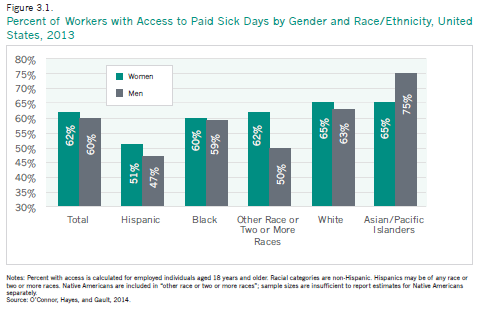
| Percent of Workers with Admission to Paid Sick Days by Gender and Race/Ethnicity, United States, 2013 | Women | Men | |
White | 65% | 63% | |
Hispanic | 51% | 47% | |
Blackness | lx% | 59% | |
Asian/Pacific Islanders | 65% | 75% | |
Other Race or 2 or More Races | 62% | l% | |
Total | 62% | lx% | |
Percent with Access to Employer-Provided Paid Leave Benefits for Full-Fourth dimension and Part-Time Workers, 1992/3 and 2012 | Paid Holiday Days | Paid Sick Days | Paid Family unit Get out |
Full-time workers 1992/3 | 92 | 58 | 2 |
Total-time workers 2012 | 91 | 75 | 13 |
Role-fourth dimension workers 1992/iii | 40 | xvi | 1 |
Role-time workers 2012 | 35 | 23 | four |
| Note: Percent of workers with access to paid sick days are calculated for employed individuals historic period 18 years and older that responded yes or no to the post-obit question: Do you have paid ill exit on your chief job or business organization? "Other not Hispanic" category includes American Indian or Alaska natives, and individuals reporting multiple racial identities. None of these populations were individually large plenty for separate analysis; all were kept in the involvement of inclusion. Percent with admission to employer-provided paid leave benefits includes private employers only. National Bounty Survey data for 1992 and 1993 were combined to create a sufficient sample for analysis. | |||
| Source: Information for pct of workers with admission to paid sick days is Institute for Women's Policy Research (IWPR) assay of the 2013 National Health Interview Survey (NHIS). Data for per centum with access to employer-provided paid exit benefits is IWPR compilation of data from Van Giezen 2013. | |||
Elder and Dependent Care
A quarter of the adult population under the age of 65 (24 percent) and an even larger share of those older than 65 (39 pct) have one or more disabilities (Centers for Disease Control and Prevention 2015; West et al. 2014). While many elderly people and many people with disabilities alive salubrious and contained lives, indeed, may provide support—financial or otherwise—for their families rather than needing back up, many others rely on the care of family members to function. According to the 2009 National Caregiving Written report, 66 1000000 people provided informal intendance to an adult during that year, and over 40 million provided intendance for an developed in need of assist with daily living (National Alliance for Caregiving and AARP 2009a,b).
Read More See the Data
| Women's Share of All Part-fourth dimension Workers by Reason for Function-time Piece of work, 2013 | |
All who usually work role-time | 63.8% |
Retired or Social Security limit on earnings | 49.2% |
Slack piece of work or business conditions | 51.4% |
In school or grooming | 56.five% |
Could find simply office‐ time work | 59.0% |
Other family or personal obligations | 90.1% |
Child care problems | 93.9% |
| Notes: Part-time workers are those who usually work between 1 and 34 hours per week. Women'south share of all part-time workers is shown as the "main reason" for working part-time given by respondents. | |
| Source: IWPR calculations based on U.Due south. Bureau of Labor Statistics 2013b. | |
State and Local Laws to Back up Caregivers at Work
Caregiver discrimination: A number of states have passed laws to protect family unit caregivers from discrimination at work (such every bit being fired for needing leave or denying leave for caregiving reasons or non being hired or promoted because one has caregiving responsibilities; Redfoot, Feinberg, and Smith Fitzpatrick 2014; Williams, Devaux, Petrac, and Feinberg 2012). The U.S. Equal Employment Opportunity Commission (EEOC) has antiseptic that both under Title 7 of the Civil Rights Act and nether the Americans with Disabilities Deed it constitutes bigotry for an employer to care for a person adversely considering he or she is a family caregiver or "associated with a person with a disability" (U.S. EEOC 2007). A number of states accept issued laws to extend protections for family unit caregivers beyond what is covered in federal laws; virtually statutory protections in this field, notwithstanding, accept happened at the local level in cities and districts (Williams et al. 2012).
Read More
Mothers as Breadwinners
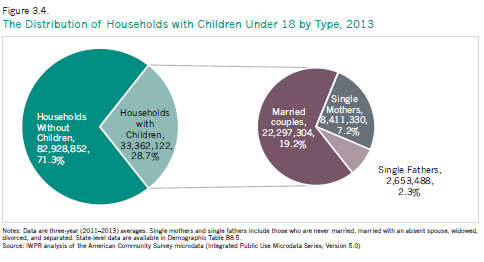
The large majority of mothers are in the workforce, including 62 percent of mothers who gave nascency within the last 12 months (U.Southward. Section of Labor Women'southward Agency 2015). One in iii workers (32 percent) have children under xviii, and of these, a quarter take children younger than 6 years old (U.S. Bureau of Labor Statistics 2014). Of the 33.4 million households with children under 18, 22.3 million are headed by married couples, eight.4 one thousand thousand past unmarried mothers, and 2.7 meg by unmarried fathers (Figure three.4). Married fathers also spend more than fourth dimension on child care than previously. Both mothers and fathers need accommodations at work, such equally schedule flexibility.
Read More Run into the Information
| Breadwinner Mothers in Households with Children nether xviii, 2013 | ||
Number | Per centum | |
Households With Children Nether 18* | 33,280,267 | 28.6% |
Households with a Breadwinner Mother** as Percent of all Households with Children | 49.8% | |
Single Mothers as Percent of All Female person Breadwinners** | fifty.7% | |
Married Couples With Female Breadwinner** as Percent of All Married Couples | 37.4% | |
| Notes: Data are three-year (2011–2013) averages. *As percent of all households in the state. **A breadwinner mother is defined as a single mother who is the main householder (irrespective of earnings) or a married female parent who earns at least 40 percentage of the couple's joint earnings; single mothers who alive in someone else's household (such every bit with their parents) are non included. | ||
| Source: IWPR analysis of American Customs Survey microdata (Integrated Public Use Microdata Series, Version 5.0). | ||
Child Intendance
Reliable child care back up is essential for parents' employment. Quality early care and pedagogy also promote children's school readiness and have positive effects that terminal into adulthood (Yoshikawa et al. 2013) and are of import for developing economically vibrant communities (Warner 2009). Land policies on child care and early care and education unequal er on many aspects, including access and aff ordability of provisions, the number of hours provided by public programs, the preparation and supports available to/required of providers and teachers, after school and schoolhouse vacation care, subsidies for depression-income parents, and guidance provided to parents choosing providers (see for example Barnett et al. 2013; Kid Intendance Enlightened of America 2013 and 2014a; Minton and Durham 2013; QRIS Compendium 2015; Schmit and Reeves 2015; Schulman and Blank 2013). The child care component of the piece of work and family composite index focuses on just three indicators: the costs of total-time center intendance for an babe every bit a proportion of the median annual earnings for women in the state, a measure chosen to illustrate the potential barriers created by the costs of care for families considering having children generally and particularly for mothers of young children who desire to return to work; the share of four-year-olds who are in publicly funded Pre-K, Headstart, and Special Educational activity; and policies in identify to ensure quality of Pre-Grand care (each is discussed in greater detail below). States vary widely beyond these indicators.
Read More Come across the Data

| Percentage of Children Eligible under Federal Child Care Subsidy Parameters Who Received Child Care Subsidies, past Age and Poverty Status, 2011 | ||
All Eligible Children | Less than 100 % Poverty | |
Infants | 12% | 25% |
Ages 1-ii | 28% | 56% |
Ages iii-4 | 30% | 62% |
Ages 5-12* | 12% | 27% |
| Notes: Children living in households with incomes less than 85 percent of country median household incomes are eligible under federal parameters, field of study to their parents' coming together piece of work or preparation rules; states can set more restrictive eligibility rules. *Includes eligible children with a disability under the age of 19. | ||
| Source: IWPR compilation based on ASPE (2015). | ||
The Gap in Mothers' and Fathers Labor Force Participation Rates
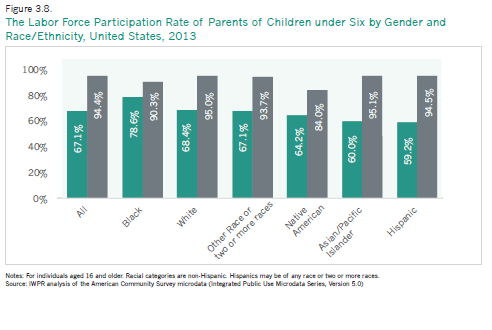
During the past four decades, the labor strength participation rate for mothers of children under six has more than doubled, from just under a third (32.1 percentage) in 1970 to but over 2 thirds (67.1 percentage) in 2013 (IWPR 2015a). During the same flow, the labor force participation charge per unit of fathers hardly changed at all, falling from 97.9 percent in 1970 to 94.four percentage in 2013. Trends in the allocation of fourth dimension between paid piece of work, child intendance, and housework between 1975 and 2011 show that both mothers and fathers of young children now spend more time on these iii activities than they did forty years ago (Figure 3.vii). Yet, while mothers spend more fourth dimension in paid work and fathers more fourth dimension on housework and kid care, overall mothers still exercise the large majority of family work and fathers withal do the majority of paid piece of work.
Read More See the Information
| Time Spent on Paid Piece of work, Housework, and Kid Intendance, Mothers and Fathers, 1975 and 2011 | Paid Work (hrs/wk) | Housework (hrs/wk) | Kid Care (hrs/wk) |
Mothers 1975 | 14.9 | 23.6 | 8.half-dozen |
Mothers 2011 | 21.4 | 17.viii | 13.5 |
Fathers 1975 | 41.4 | half dozen.0 | 2.6 |
Fathers 2011 | 37.1 | 9.8 | 7.iii |
Labor Strength Participation Rate of Parents of Children under Six by Gender and Race/Ethnicity, United states of america, 2013 | Mothers | Fathers | |
All | 67.1% | 94.4% | |
Black | 78.vi% | 90.3% | |
White | 68.4% | 95.0% | |
Other Race or Two or More Races | 67.1% | 93.7% | |
Native American | 64.2% | 84.0% | |
Asian/Pacific Islanders | sixty.0% | 95.1% | |
Hispanic | 59.two% | 94.5% | |
| Note: Time spent past mothers and fathers, 1975 and 2011, includes resident parents of children under eighteen. Labor force participation of parents includes individuals aged 16 and older. Racial categories are non-Hispanic. Hispanics may be of whatsoever race or 2 or more races. Native Americans are included in "other race or two or more races;" sample sizes are insufficient to study estimates for Native Americans separately. | |||
| Source: Time spent by mother and fathers, 1975 and 2011, is IWPR compilation of data from Pew Research Center 2015. Labor force participation of parents is IWPR analysis of the American Community Survey microdata (Integrated Public Apply Microdata Series, Version 5.0). | |||
View Boosted Information by Country
View additional tables with country-level data on the indicators discussed in this section.
View Additional Information by State
Download the Data
Land-level data are bachelor on paid leave legislation, per centum of women living with a person with a disability, elder and dependent care indicators, breadwinner mothers, child care indicators, child care subsides, and the gender gap in parents labor strength participation rates.
- Work & Family unit
clevelandstine1951.blogspot.com
Source: https://statusofwomendata.org/explore-the-data/work-family/
0 Response to "How Did the Numbers and Conditions of Women Affect Family Life"
Post a Comment